


Non-intentional Modes of Consciousness in Phenomenology
Non-intentional Modes of Consciousness in Phenomenology: Call for Papers
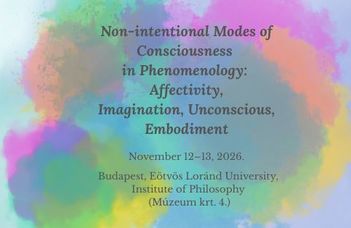
Throughout the long history of phenomenology, alongside intentional modes of consciousness, so-called non-intentional forms of consciousness have played an increasingly significant role: affectivity, fantasy, unconscious, embodiment, etc. The main aim of the conference is to provide an overview of past and contemporary research of non- intentional forms of conscious functioning.
Conference venue: Budapest, Eötvös Loránd University, Institute of Philosophy (Múzeum krt.4.)
Conference dates: November 12–13, 2026.
Suggested topics:
- embodiment, bodily existence, bodily memory
- affectivity, emotions, existential moods
- phenomenological unconscious, association, passive syntheses
- psychology, psychoanalysis and phenomenology
- phenomenology and cognitive sciences
- intersubjectivity, culture, sociality
- understanding, interpretation, narrativity
We are accepting submissions with abstracts of up to 500 words until July 31, 2026 at the following email address: phenomenology.conf2026@gmail.com
Please send a brief introduction, including your affiliation, in a separate document. We will send notifications regarding accepted presentations by August 10, 2026. There is no registration fee.
Confirmed plenary speakers:
- Thiemo Breyer (University of Cologne)
- Natalie Depraz (University of Rouen Normandy)
- Thomas Fuchs (Heidelberg University) online
- Sarah Heinämaa (University of Jyväskylä)
- Dieter Lohmar (University of Cologne)
- Dermot Moran (Boston College) online
- Dan Zahavi (University of Copenhagen) online
We warmly welcome all interested parties.
The organizers
Tamás Ullmann, Professor of Philosophy
Csaba Olay, Professor of Philosophy
Bence Péter Marosán, Associate Professor